Assoukrou Aké
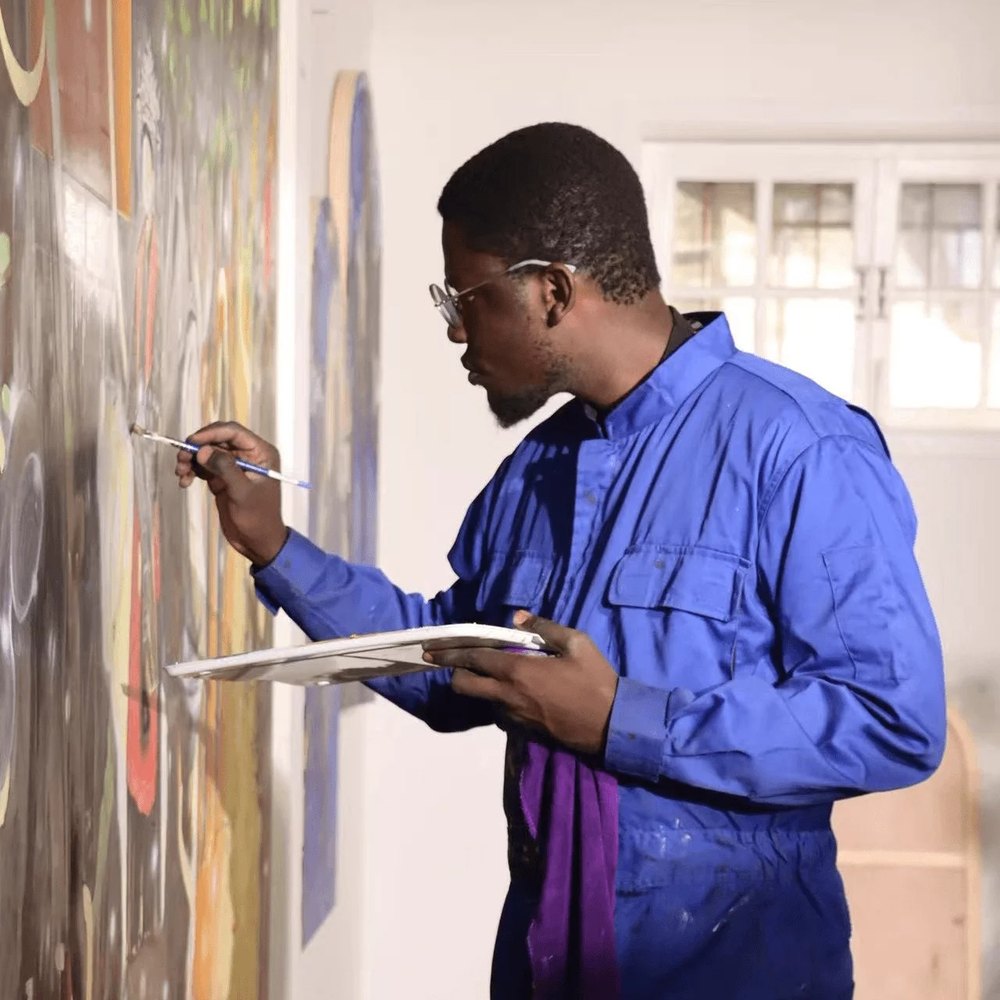
Born 1995 in Bonoua, Côte d'Ivoire. Lives and works in Paris.
Born in 1995 in Bonoua, Côte d’Ivoire, Assoukrou Aké lives and works in Paris. After an arts baccalaureate in Côte d’Ivoire, he continued his studies in France, first in art history and archaeology at Université Paris Nanterre, then at the École supérieure d’art et de design in Tours, from which he graduated in 2021. This passage through art history is not incidental. His work retains something of that attention to images: to where they come from, to the ways they are handed down, classified and reproduced, then transformed as they change era, territory or context.
More about the artist →
Assoukrou Aké works in sculpture, installation, printmaking and textile without setting up any hierarchy between these practices. They answer one another, extend one another and at times contradict one another. Printmaking carries with it the question of the imprint and of repetition; textile brings in transmission, covering, assemblage; sculpture introduces weight, volume, physical presence. These mediums are therefore never mere supports. They take full part in the way the artist questions what remains of a history once it has been displaced, fragmented or partly erased.
For several years, Aké has been building what he calls a “healing narrative”. The term might suggest a wish to repair. It designates rather a way of returning to certain histories without claiming to resolve them. His family history, the silences that go with it, the movements between Côte d’Ivoire and France mingle with wider narratives: those of colonisation, of representations of Africa, of medicine, of political violence and of transmission. The personal is never far away, but it does not take the form of a confession. Aké uses it as a point of entry into narratives larger than himself.
His works are peopled with images that seem to have already lived several lives. A reference to African mythology may sit alongside a European engraving, a press photograph, a religious motif or the memory of an orally transmitted story. This could make an inventory. It produces instead a palimpsest. Some images remain immediately recognisable; others seem to have lost part of their origin along the way. Aké does not always seek to reconcile them. He prefers to keep something of their mutual strangeness. It is often in this imperfect proximity, in this slight misalignment between two regimes of images, that his work becomes most precise.
Among the figures that recur in his work are characters whose faces are replaced by spirals. One might see in them the rings of a tree, a fingerprint, or a way of withdrawing the face from identification. For Aké, these lines also speak of time and of lineage. They make the face less a portrait than a surface of inscription. The individual partly disappears, but something of his history remains. These figures are anonymous without being deprived of memory.
The horse also returns often, particularly in the prints. It is an ancient, laden figure: that of conquests, processions, power and heroic tales. Aké takes it up without keeping its majesty intact. His horses sometimes seem to carry the very weight of the imagination they embody. They move forward with history on their backs. Power then becomes ambiguous: it already contains the possibility of its fall.
There is in his work an evident taste for what he calls the “counter-gesture”. Remaking a known form, but differently. Using a material where it is not expected. Repeating a motif until it stops producing the same meaning. Shifting a symbol just enough for its self-evidence to blur. He also speaks of “the reverse”, not as a secret reality to be revealed, but as what one begins to see when looking at an image from another history.
This attention to displacement is essential. Aké does not destroy the images he borrows; he knocks them off their axis. He temporarily takes away their comfort. A historically dominant form can become fragile; a material deemed secondary can suddenly occupy the space; a familiar symbol can lose its authority when it meets a narrative that had until then been foreign to it. It is less an art of quotation than an art of decentring.
Memory thus appears less as a subject than as a working method. It returns in fragments, through repetitions, sometimes through anamnesis. Nothing is truly restored to its first state. The eras themselves intermingle: the colonial past, an older mythology, a contemporary experience or an image found today can belong to one and the same work. This heterochrony gives his work a particular temporality. The past is never held at a distance. It insists in the present.
“The characters I bring into existence in my work form, fragment by fragment and radiating outwards, an archive of African consciousness that mingles the sacred and the profane the better to reveal the essence of human life, that of a fragmentary identity still to be reinvented,” the artist explains. This idea of the archive matters, provided it is not understood in a documentary sense. The one Aké builds is lacunary, subjective, at times contradictory. It gathers precisely what resists the single narrative.
Perhaps this is where his work holds: in this refusal to fill the gaps too quickly. An interrupted history is not artificially reconstructed. A wounded image is not returned to its original state. Aké works with the gap itself, as if it could become a form.
This is how his “healing narrative” should be understood. Not as the promise of mending what has been broken, but as the possibility of producing something out of what remains incomplete. In his hands, the work does not close history. It gives it another surface on which to go on appearing.
Winner of the ellipse Prize in 2022, Assoukrou Aké has taken part in several residency programmes, and his work has been shown in France, Côte d’Ivoire, Togo, Germany, Spain and China. His recent presentations include Bleu de Chine at Yishu 8, Paris, and Ce qui brille derrière la nuit at the Maison des Arts of Yishu 8 in China in 2026; El Árbol – Raíces, Conexión y Trascendencia at the Casa de Velázquez in 2025; Les graines de semence ne doivent pas être moulues at Galerie Cécile Fakhoury, Abidjan, in 2024; La noche de la frontera in Madrid, Jeune Création at the Espace Niemeyer and Moi – L’autre at the Ateliers du Plessix-Madeuc in 2023. His work has also been presented at AKAA with Ellipse Art Projects, at the Biennale artpress at MO.CO. Montpellier, at EUARCA+ alongside documenta fifteen in Kassel, and in the exhibition About Now #2 at Galerie Cécile Fakhoury in Abidjan in 2022.
Education 5→
- 2026
- Modeleur BIM du bâtiment, HUPSO, Paris
- 2023
- Bachelor, design d'espace (2e et 3e années), École supérieure d'art ESDAC, Lille
- 2021
- DNSEP, option art, avec les félicitations du jury, École supérieure d'art et de design TALM, Tours
- 2019
- DNA, option art, avec les félicitations du jury, École supérieure d'art et de design TALM, Tours
- Histoire de l'art et archéologie, Université Paris Nanterre
Solo exhibitions 6→
- 2027
- Theobroma Cacao, Posologie des trois mondes, Galerie Cécile Fakhoury, Abidjan (à venir)
- 2026
- Bleu de Chine, Yishu 8 × Tante Martine, Paris
- 2025
- Ce qui brille derrière la nuit, Maison des Arts de Pékin, Yishu 8, Pékin, Chine
- 2024
- Les graines de semence ne doivent pas être moulues, Galerie Cécile Fakhoury, AbidjanL'histoire s'affiche sur les murs, Le 6b, Saint-Denis
- 2022
- Car Dieu a tant aimé le monde, AKAA (Also Known As Africa), avec Ellipse Art Projects, Paris
Group exhibitions (selection) 37→
- 2026
- Paris noir, Centre Pompidou × Fondation Clément, Martinique (décembre)Stereo Fetish, Musée Adama Toungara, Abobo, Côte d'Ivoire (novembre)Créolisation, Atelier Fabien Hulin, Saint-Ouen (octobre)Nourrir les débris, Ancienne brasserie de l'Atlas, Bruxelles (octobre)Ellipse, Ellipse Art Projects, Carreau du Temple, Paris (octobre)Le temps du rêve de l'enfant, Galerie Cécile Fakhoury, AbidjanLa vie climatique, triennale de l'ADIAF, [mac] musée d'Art contemporain, MarseilleBabel bleu, Yishu 8, Wilde, Paris
- 2025
- Echo Nest, A4 Art Museum, Chengdu, Sichuan, ChineEl Árbol – Raíces, Conexión y Trascendencia, Casa de Velázquez, MadridKaléidoscope 2, Pavillon Comtesse de Caen, ParisTactical Specters, La Ferme du Buisson, Noisiel
- 2024
- ArtLibris, ARCO Madrid × Casa de Velázquez, MadridKaléidoscope 1, Casa de Velázquez, MadridMémoire d'un écho, Nuit blanche, Lou & Lou Foundation × Casa de Velázquez, la Conciergerie, ParisAsí que pasen diez años, Galería Silvestre, MadridTransformer.S, Collection Lambert, AvignonMythologieS, Centre culturel Georges-Ginesta, Saint-RaphaëlLa Sagrada Familia Is Under Construction, Fundación Sandretto Re Rebaudengo × Ateneo de MadridApparitions, Galerie Cécile Fakhoury, Paris
- 2023
- La noche de la frontera, Casa de Velázquez × Institut français de MadridJeune Création, 73e édition, Espace Niemeyer, ParisMoi – L'autre, Ateliers du Plessix-Madeuc, BretagneRefuges, Galerie Cécile Fakhoury, Paris
- 2022
- Le Clou 13, biennale des Amis du musée d'Arts de Nantes, L'Atelier, NantesLes Vibrations du monde, Galerie du passage Chabrier, Saint-Pierre-des-CorpsArtMessiamé, Musée Paul Ahyi, Lomé, TogoEuropean Art Camp + (EUARCA+), en marge de documenta fifteen, Kassel, AllemagneAprès l'école, 2e Biennale artpress, musée Fabre, MO.CO. Panacée et Espace Dominique-Bagouet, MontpellierAbout Now #2, Galerie Cécile Fakhoury, Abidjan14e prix ICART Artistik Rezo, Fluctuart, Paris
- 2021
- 5e prix Paris 1 Panthéon-Sorbonne, Paris6e prix Juvenars-IESA, galerie de l'IESA, ParisTravelling danses, Université Toulouse-Jean-Jaurès, ToulouseBird Sing, journée professionnelle de l'ESAD TALM, Tours
- 2019
- Oh les beaux jours !, Ancienne imprimerie Mame, ToursHiérarchie et politique du vivant, colloque-exposition, ESAD TALM, Tours
Awards 8→
- 2024
- Prix Yishu 8, lauréatPrix Art Éco-Conception, Art of Change 21 × Palais de Tokyo, lauréat
- 2023
- Nommé pour le 4e Henrike Grohs Art AwardPrix indépendant du 6b, lauréat
- 2022
- Prix ellipse, lauréatPrix du public ICART Artistik Rezo, lauréat
- 2021
- Nommé pour le 5e prix Paris 1 Panthéon-SorbonneNommé pour le 6e prix Juvenars-IESA
Residencies 9→
- 2026
- Résidence Polyominos, Nancy
- 2025
- Yishu 8, Maison des Arts de Pékin, ChineThread, Fondation Josef et Anni Albers, Sinthian, Sénégal
- 2024
- Fondation Pilar et Joan Miró, Majorque, Espagne
- 2023
- Casa de Velázquez, MadridAteliers du Plessix-Madeuc, Bretagne
- 2022
- ArtMessiamé, Musée Paul Ahyi, Lomé, TogoEUARCA+, en marge de documenta fifteen, Kassel, Allemagne
- 2021
- Ateliers de la Morinerie, Saint-Pierre-des-Corps
Collections 6→
- Fondation Pilar et Joan Miró, MajorqueCasa de Velázquez, MadridFondation Société Générale, Côte d'IvoireEllipse Art Foundation, FranceInstitute Museum of Accra, GhanaAfrica First, Israël
Bibliography 6→
- 2026
- Précis d'anatomie et d'une dissection, monographie, Nancy, Les Presses des Pionniers, 2026. Textes d'Edem Allado, Oulimata Gueye, Smaïl Kanouté et Ludovic DelalandeDe leur temps. La vie climatique, ADIAF, Silvana Editoriale
- 2024
- Kaléidoscope, artistes en résidence 2023-2024, Madrid, Casa de VelázquezNid d'artistes, Abidjan et CasablancaJean-Baptiste Naudy, « Les graines de semence ne doivent pas être moulues », texte de l'exposition, Galerie Cécile Fakhoury, Abidjan
- 2022
- DEAM Magazine, n° 1, mars 2022, Berlin
Conférences et rencontres 6→
- 2027
- « De la pratique au discours », ambassade d'Espagne en Côte d'Ivoire (janvier)
- 2026
- Lancement de Précis d'anatomie et d'une dissection, Palais de Tokyo, ParisTable ronde autour de Précis d'anatomie et d'une dissection, Wilde, Paris
- 2024
- Journée d'étude sur la gestion des différences en situation coloniale, Madrid
- 2023
- Viva Villa !, Gaîté Lyrique, Paris
- 2022
- Échange artistique, Cité internationale des arts, Paris