Jean Prouvé was never an architect, and he insisted on the word: he called himself a constructor. The son of a painter, trained at the forge before he was trained in calculation, he spent his life demonstrating that a building could come out of a workshop the way a production part does, folded, bolted, carried away, re-erected somewhere else.
His career turns on a single shift: from art metalwork to folded sheet. The 1925 Exposition des Arts Décoratifs made him abandon wrought iron for welding and thin steel; four years later he filed his first patents under the title of constructor and, with his friends, founded the Union des Artistes Modernes. Furniture, partitions, façades, whole houses: all came off the same machines.
The Maxéville works, which he set up near Nancy in 1947, were that idea at its height, a factory where drawing and making happened on the same day. It was from there that the two demountable schools of Bouqueval and Vantoux came in 1950. Two years later his shareholders shut him out of it. He would speak of it as a death.
The second half of his life was that of a man without a factory: a design office in Paris, the building department of CIMT and the invention of the curtain wall, a chair at the Conservatoire National des Arts et Métiers where for thirteen years he taught how to read technical objects. In 1971, chairing the jury of a Paris competition, he pushed through the project of two unknowns, Renzo Piano and Richard Rogers: the Centre Pompidou would be a steel structure, a modular façade, open floors. His principles, built by others.
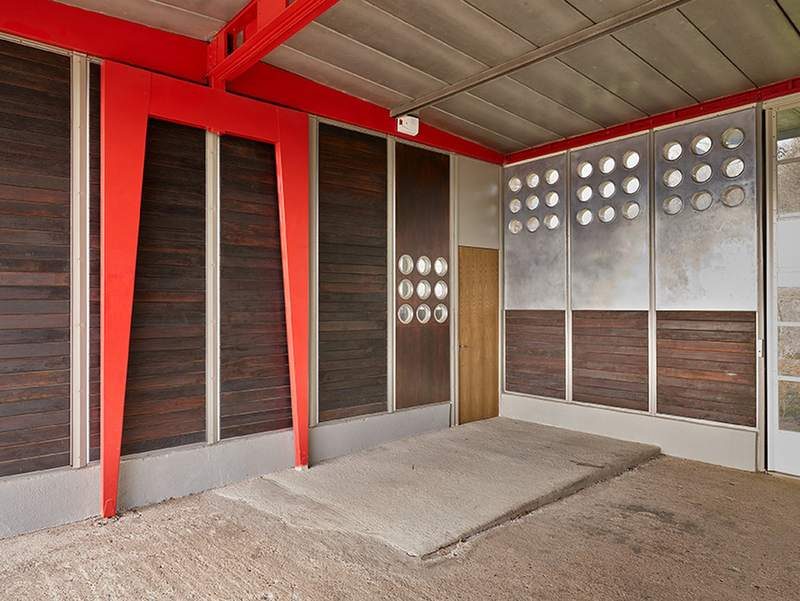
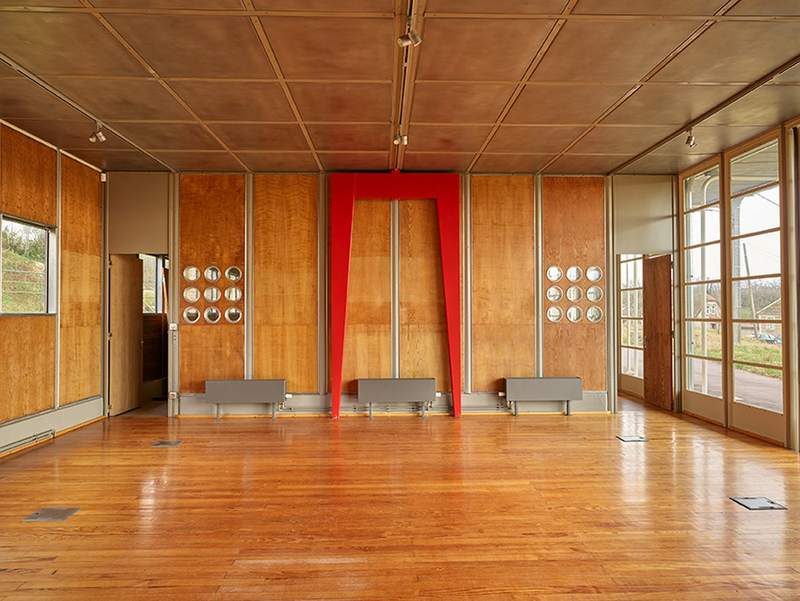
The gallery occupies one of his two schools. That is the reason for this page: you cannot hang work inside a grid without knowing who set it out.
- 1901
- Born in Paris on 8 April, second of seven children. His father Victor Prouvé was a painter and president of the École de Nancy; his mother Marie Duhamel was a pianist
- 1916-1919
- Beaux-Arts in Nancy, then apprenticeship with the metalworker Émile Robert at Enghien-les-Bains: he learned metal by hand before he learned it by calculation
- 1924
- Opens his ironwork shop on rue du Général-Custine, Nancy — grilles, railings and fittings across Lorraine
- 1925
- The Exposition des Arts Décoratifs turns him away from wrought iron: he moves to folded sheet, thin steel and welding
- 1929
- Founding member of the Union des Artistes Modernes. First patents filed under the title of constructor: movable partitions, metal doors, sash windows
- 1931
- Founds the Ateliers Jean Prouvé on rue des Jardiniers. Furniture and buildings now come off the same machines
- 1936
- Buys a press able to fold four metres of sheet. Maison du Peuple at Clichy, with Beaudouin, Lods and the engineer Bodiansky
- 1939-1944
- Several hundred demountable huts for the army, then war production. He joins the Resistance
- 1944
- Appointed mayor of Nancy at the Liberation, from September to the following spring
- 1947
- The Ateliers leave Nancy for the Maxéville factory: drawing and making happen on the same day
- 1950
- Demountable schools at Vantoux and Bouqueval, with Henri Prouvé. The same year the Maison Tropique is erected at Maxéville before leaving for Niamey
- 1952
- His shareholders bar him from Maxéville; he resigns. “I died in 1952,” he would say
- 1954
- Aluminium centenary pavilion, a hundred and fifty metres long, erected in three weeks on the banks of the Seine. That same year he builds himself a house in Nancy, on ground said to be unbuildable
- 1956
- Maison des Jours Meilleurs, his answer to the abbé Pierre's appeal: erected in seven hours, refused by the technical authorities
- 1957-1970
- Chair of applied arts at the Conservatoire National des Arts et Métiers. At the same period CIMT puts him in charge of its building department: the curtain-wall years
- 1963
- Auguste Perret Prize, awarded by the International Union of Architects
- 1971
- Chairs the international jury for the future Centre Pompidou and carries the project of Renzo Piano and Richard Rogers
- 1981
- Erasmus Prize; Commander of the Légion d'honneur
- 1984
- Dies in Nancy on 8 December, aged eighty-three
Bibliography12
Each title verified with its publisher or with an institution. Publications by commercial galleries have been left out.
Written for this site from public sources. Facts are checked, not copied.