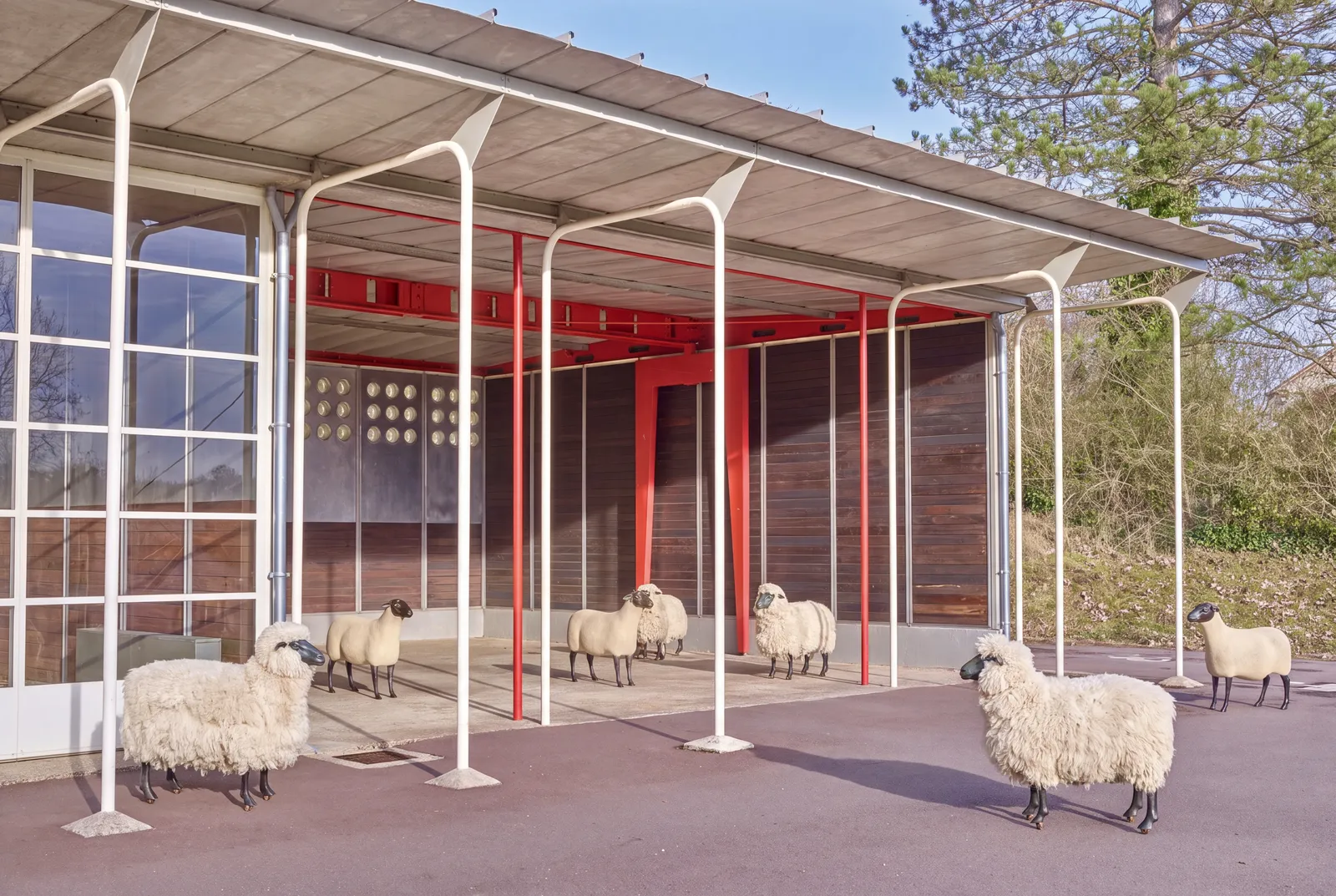
Barely gathered, François-Xavier Lalanne's Moutons change the scale of the School at Vantoux. The ceiling seems lower, the corridor longer, the light slower. Nothing has been added to the building except a few bodies that do not breathe and that nonetheless give it back a form of life. At Galerie Nathan Chiche the flock has crossed the light, brushed past wood and metal, then taken its place in the school. You would look in vain for a reconstructed meadow. There is no grass, no sky, no pastoral setting. Something less certain has happened. The school has remembered that it could be a landscape. The outside is no longer behind the windows. It surfaces in the room, around the works, between two silences. The architecture draws its enclosure.
The School at Vantoux does not serve as a backdrop to the sculptures. Designed by Henri and Jean Prouvé, it imposes its measure, its materials, the candour of its assemblies. The metal does not disguise itself. The wood does not try to look more precious than it is. The portholes pierce the panels without interrupting their logic. Everything shows how the building stands, how it opens, how light crosses it. “Space seized by the imagination cannot remain the indifferent space handed over to the measure and the reflection of the geometer,” wrote Gaston Bachelard¹. At Vantoux the imagination does not come to correct geometry. It discovers what geometry already contained. A wall becomes an edge of woodland. A corridor takes on the depth of a path. Prouvé's tectonics remain legible, but they now act upon the gaze as much as upon the construction. You have to walk through the school to understand it. The body measures what the eye alone could not grasp.
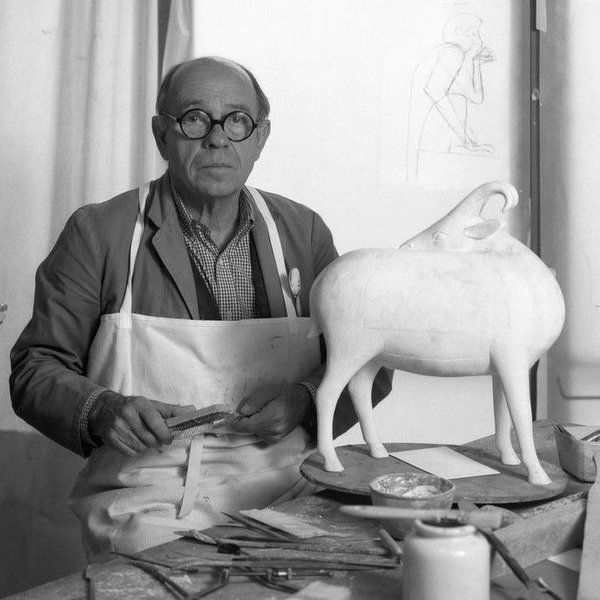
François-Xavier Lalanne understood very early that an animal could unsettle the most firmly established categories. In 1965, at the Salon de la Jeune Peinture, he showed twenty-four Moutons in bronze and wool, mounted on castors. The group bore the title Pour Polyphème, after the episode of the Odyssey in which Ulysses and his companions escape the Cyclops hidden beneath his flock. In the middle of a salon devoted to painting, Lalanne offers not an image but a presence. He does not represent sheep. He brings them in. “It is easier to have a sculpture in your living room than a real sheep, and better still if you can sit on it,” he liked to recall². All of Lalanne is held in the hidden seriousness of that sentence. A sculpture can be approached, touched, used. It becomes no less mysterious for that. The porousness between the work, the furniture and the animal is not indecision. It is the very space of his freedom.
It is perhaps at precisely this point that Lalanne meets Prouvé. Not in a resemblance of forms, still less in an agreement of style, but in the same will to make things habitable. Prouvé makes industry habitable. He turns the panel, the folded sheet, the portal frame and the production run into architecture for bodies. Lalanne makes sculpture habitable. He allows it to enter a room, to receive a gesture, sometimes the weight of a person. In both, function does not come after form. It takes part in its birth. Use does not diminish the work. It gives it an address. It inscribes it in the world without dissolving it there. This proximity explains the rightness of their meeting. The Moutons are not deposited in a monument. They join a way of thinking that was foreign to them, but which recognises their manner of binding form to life.
A single Mouton retains the authority of a sculpture. Several Moutons bring a territory into being. The group does not add works together, it changes their nature. A head turns, a body moves aside, a void opens. The flock has its order, but that order remains impossible to fix. Its hieratic quality is without solemnity. It has more to do with attention, as though each figure were listening to the room. The visitor enters that listening. He no longer looks at the works from a stable point. He passes between them, alters the distances, becomes momentarily one body among others. The exhibition does not deliver itself in a single glance. It is built by walking, according to the proximities, the separations and the perspectives each person brings into being. Sometimes one Mouton conceals another. Sometimes the flock comes apart, then re-forms a few steps further on.
Prouvé repeats panels and portal frames. Lalanne repeats an animal form. Yet nothing appears identical. In their hands the series does not produce uniformity; it makes differences perceptible. The metal panels are answered by the aligned bodies. The portholes, by the dark faces. Metal returns the light, wool holds it. Between the two, light almost changes state. These correspondences never compose a decor. They are discovered slowly, then disappear depending on where one stands. The Moutons do not come to soften Prouvé. Prouvé does not come to discipline Lalanne. Each leaves the other intact, but visible otherwise. The building gives the flock a new precision. The flock makes the sensuous part of the building perceptible. The room becomes a meadow without losing its walls. The corridor becomes a passage without ceasing to be a corridor.
“What comes into the world to disturb nothing deserves neither regard nor patience,” wrote René Char³. Here the disturbance works under its breath. No spectacular gesture. No conquest of the place. A woollen back beneath a porthole is enough. A dark head before the aluminium is enough. The logic of the school shifts by a few degrees and the real shifts with it. This transfiguration stays light because it erases nothing. It reveals. The title The School Is in the Meadow therefore describes no rustic fancy. It formulates a reversal. The meadow is no longer what one glimpses outside; it becomes an interior quality of the space. The school, for its part, never disappears behind the landscape. It gives it a limit, a construction, a rhythm. In Prouvé, Lalanne finds an enclosure. Beside Lalanne, Prouvé lets a meadow appear.
At the border of sculpture, furniture and the living, the flock displaces our perception of the place. It reveals how far a work can transform the reading of an architecture without ever altering its rigour. The exhibition does not ask us to choose between the object and the animal, between function and poetry, between the school and the meadow. It holds these realities together, in a balance that remains slightly unstable. That is where the epiphany occurs, at the moment when something we thought we knew, a seat, a sheep, an architecture, suddenly appears in all its strangeness. Then the light circulates differently, the distances begin again and the space seems to breathe. The school is in the meadow. The meadow, from now on, remains in the school.