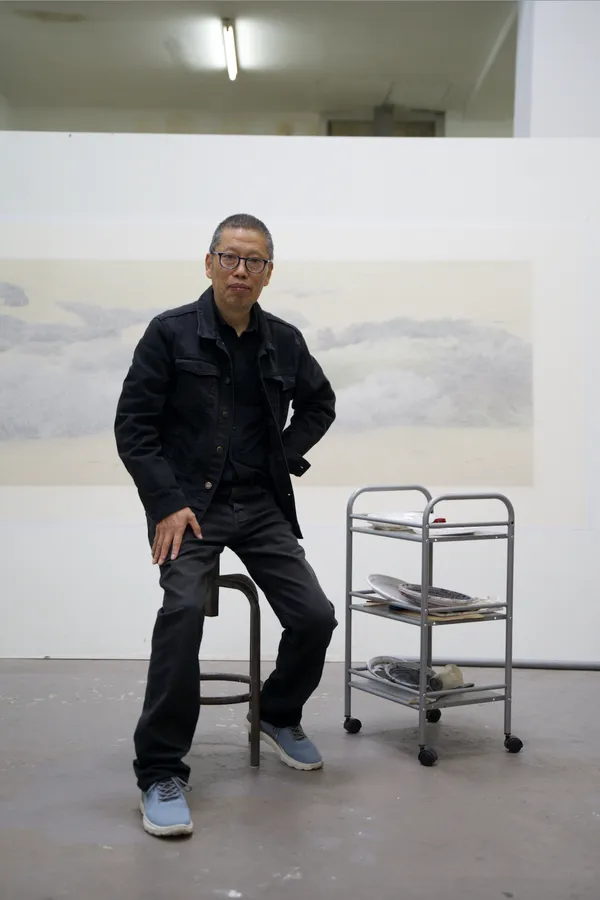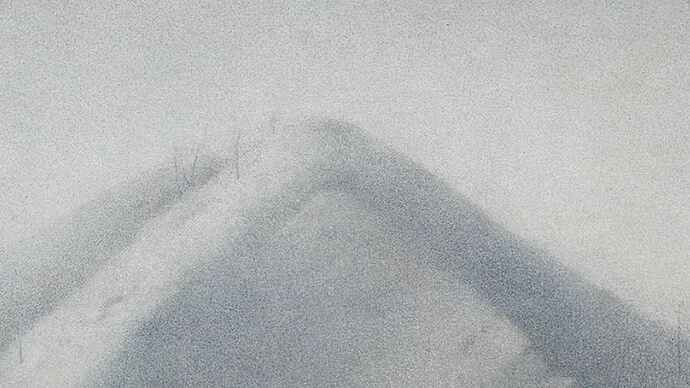
To contemplate a work by Shan Weijun is to cross a threshold. The ink, fluid and unruly, does not seek to fix an image but to reveal a world in the making. Every trace, every dilution, every reserve of white opens a space where the visible mingles with the invisible. His landscapes designate no precise place: they are archetypes. Canopies, boughs and foliage appear as so many breaths, invisible forces that pass through matter and, by their morphogenesis, draw a true architecture of the sensuous.
The exhibition's title, Les feuillages du auvent, concentrates this double belonging. The auvent, the canopy or awning, is in its first sense a shelter: a protective projection that filters light and organises the transition between inside and outside. But it also refers to the vegetal canopy, that moving vault formed by trees, where the wind circulates like silent music. This ambivalence lies at the heart of Shan's work: nature there becomes architecture, and architecture finds its origin again in nature.
This gesture finds a singular resonance with the work of Jean Prouvé. The engineer-architect always conceived his buildings as living organisms: slender frames, modular structures, light constructions thought out with the same economy as the branches of a tree. Lightness, mobility, rightness: principles that unite Shan Weijun's vegetal framework with Prouvé's structures. As if metal, under the architect's hand, met ink under the painter's brush in the same search for organic simplicity.
François Cheng's thought illuminates this kinship. In Vide et plein he writes: “Landscape painting does not aim to reproduce the visible, but to reveal the invisible that animates it, the breath that binds all things.” That breath, the qi, passes through every work by Shan Weijun. It animates the leaf, makes the bough vibrate, raises the trunk. The tree-woven weft becomes breath, and breath becomes architecture. Cheng adds elsewhere: “In the beauty of a tree, it is the breathing of the world that offers itself to us.” That is what his inks give us to feel: beauty as universal breathing.
Shan Weijun's trees and foliage are not naturalistic motifs. They are ontological figures: they embody a way of being in the world. Gaston Bachelard sensed it: “Every tree is a temple.” In Shan's inks, trunks are columns, foliage vaults, the woods invisible cathedrals where silence serves as foundation. These works are epiphanies: they do not merely show, they reveal.
This experience finds multiple philosophical resonances. For Merleau-Ponty, for whom “to see is to enter a universe of things that show themselves,” landscape is never object but presence. To look at an ink by Shan is to be welcomed into a phenomenological spatiality, to inhabit a space through which breath circulates. For Heidegger, in Building, Dwelling, Thinking, dwelling is the manner in which mortals stand upon the earth. Shan's vegetal vault, in its discreet monumentality, tells us this: to dwell is not to possess but to let be, to recognise in foliage a first shelter.
Poetry amplifies this meditation. Bashō, master of the haiku, wrote: “Beneath the leafy tree, no one is a stranger.” That line, simple and radical, joins what Shan's inks show: nature as a place of universal welcome. Hölderlin, in a parallel intuition, affirmed: “Full of merit, yet poetically, man dwells upon this earth.” This poetics of dwelling finds a concrete embodiment in Shan's vegetal and pictorial canopy: to dwell is to let oneself be crossed by the wind, to breathe in the shade of foliage, to share the space with what exceeds us.
To present these works in Jean Prouvé's school is a mise en abyme. The metal frames converse with the vegetal frames; the engineer's structures are superimposed on the painter's boughs. Where Prouvé invented light, open, breathing houses, Shan brings forth an organic, moving architecture in which silence becomes structure. As Le Corbusier recalled: “Architecture is the masterly, correct and magnificent play of volumes brought together in light.” Shan's inks suggest that the first architecture was that of trees, raised towards the sky, and that the light filtering through their canopies was its first stained glass.
Les feuillages du auvent is therefore more than a title: it is a metaphor. A meditation on the original architecture that nature constitutes, and on the way art makes it perceptible. It reminds us that the built and the living are not opposed but caught in the same dynamic. Shan Weijun's work shows that before raising our walls we dwelt beneath foliage, and that we continue, in truth, to seek shelter there.
— Nathan Chiche