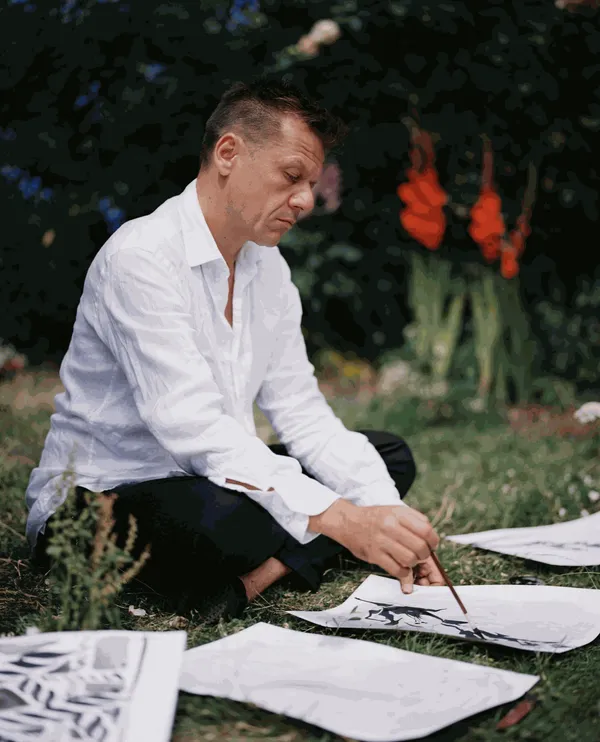
Certain encounters, though not predestined, manage to transcend time and space, inscribing a silent yet vibrant dialogue between two minds. Mircea Cantor's exhibition L'école des mondes, within the École Jean Prouvé at Vantoux, embodies that osmosis. Jean Prouvé, avant-garde genius of modern architecture, and Mircea Cantor, contemporary artist crowned with the Prix Marcel Duchamp, meet here in an intangible and powerful conversation on the uncertainty and fragility of our world.
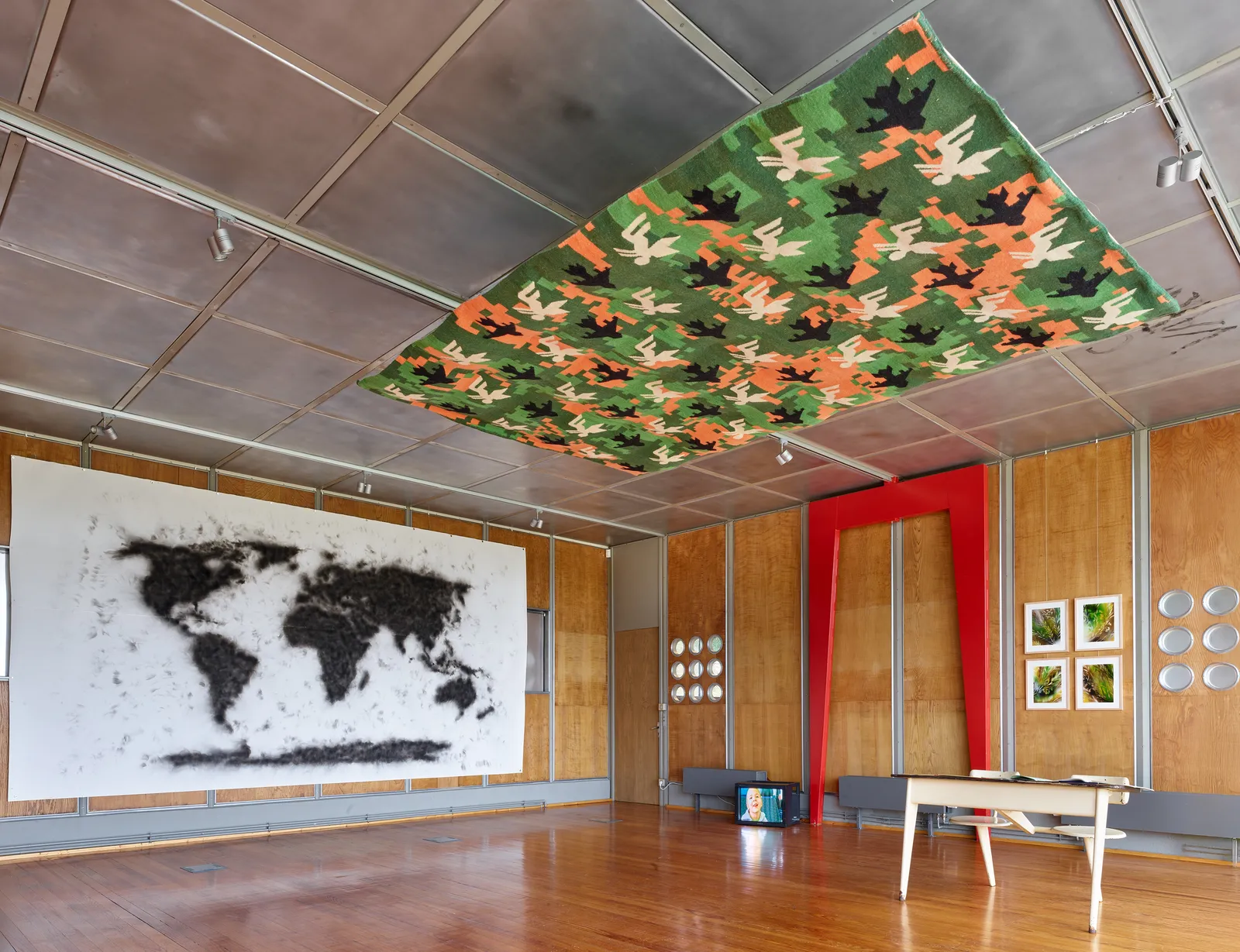
In the classroom of this institution devoted to innovation and critical thought, Cantor's burnt world maps strike by their visceral resonance. These maps, at once recognisable and deeply altered, evoke those hung in classrooms across the world, including that of the École Jean Prouvé. Yet these versions are marked by the stigmata of destruction and of the ephemeral, underlining the intrinsic instability of geopolitical borders. Cantor's burnt maps, The World Belongs to Those Who Set It on Fire, arouse a nostalgia for a vanished era, when geographical maps were perceived not only as learning tools but also as vectors of exploration and escape. They invite the visitor to contemplate not only the arbitrary lines of borders but also the histories, the cultures and the humanities that transcend those delimitations.
Incandescence is an important image in Cantor's artistic arsenal, or rather a non-image, refusing to form itself as it consumes what burns and dissolves in countless flames in search of oxygen, as Philippe-Alain Michaud subtly observes. These burns are not mere signs of destruction; they bear witness to the tension between the human effort to fix landmarks and the ineluctable forces of transformation. As Jorge Luis Borges so justly put it: “The map is not the territory.” Cantor's burns remind us that maps are not fixed representations but living reflections of humanity's evolutions. Every mark becomes an invitation to explore the historical and geopolitical windings that have shaped our world, to recognise the scars of the past, and to imagine new horizons for the future.
Beneath the ceiling of this classroom, the flying carpets of Mircea Cantor's Airplanes and Angels series levitate, transfiguring the space into a theatre of dreams and escape. One of these carpets, held in the UNESCO heritage collection as a permanent work, testifies to Cantor's deep attachment to traditional craft and to the human hand. This choice underlines the transmission of ancestral know-how, an unalterable heritage woven into every fibre. Cantor compares the carpets of Maramureș to “grandmother's pantry jam”, an evocative metaphor for the energy and visual force in which motifs of aeroplanes and angels are mingled. These suspended carpets also symbolise travel and discovery, two constitutive elements of education and formation. The Airplanes and Angels series explores the dichotomy between two worlds: the visible and the invisible.
In his work, Mircea Cantor sets out to decipher the universal and timeless concept of flight, omnipresent in his output and running through the history of aviation as much as that of myth and the arts. Cantor expresses this fascination in these terms: “Subjective, non-linear geography of flight. Flight!, which I discovered in childhood in the tale of the Maiastra bird, that magic bird which inspired Brâncuși's audacious sculptures.” In short, in order to arrive at a certain idea of the desire to fly, of the flight of the soul, of freedom.
Continuing the voyage, beneath the covered playground, Mircea Cantor's work Fishing Fly rises, both literally and metaphorically. This unusual aeroplane, assembled from flattened oil drums and metamorphosed into a gigantic fishing fly, is suspended from an imposing gilded hook, at once precious and threatening. It embodies the duality of humanity: our capacity to create and to destroy, to nourish and to deceive, but also the possibility of metamorphosis and reinvention. This aeroplane, set in counterpoint to the ideal of transparency and functionality dear to Jean Prouvé, who conceived his buildings with the precision of an aeronautical engineer, would certainly have pleased him in this juxtaposition of forms and functions, this transfiguration of the ordinary into the extraordinary. By placing this work beneath the covered playground, a space of transition and movement, Cantor invites the “pupils” to meditate on the transformations and adaptations required in a world in perpetual mutation.
This questioning finds a vibrant echo in the projection of Mircea Cantor's FIRE DOINA: in a scene at the heart of an impenetrable forest, an isolated soldier performs a Doina, the ancestral, plaintive song of Romanian tradition, on a caval, the emblematic pastoral flute. But in a gesture at once tragic and arresting, the very instrument he plays is prey to the flames. Fire, a double agent of destruction and purification, mingles with the ethereal melody, engendering a dramatic tension between the delicacy of the instant and the inexorable violence of destruction.
This exhibition, conceived to resonate with Jean Prouvé's visionary post-war spirit, constitutes a true invitation to reflection and contemplation. Cantor's works, in this unique context, take on a new dimension, conversing with the structures and forms of the school and creating an immersive and enchanting experience.
— Nathan Chicheportiche