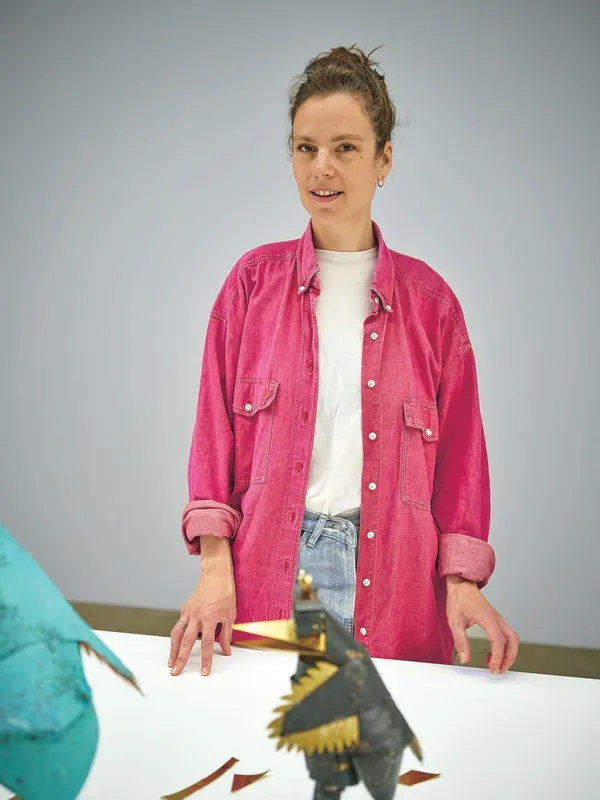
Caroline Mesquita’s colourful metal figures people a story in which each exhibition seems to open a new chapter. Their gestures, postures and exchanges gradually sketch out an autonomous world, one that extends through the artist’s sculptures, videos and immersive installations.
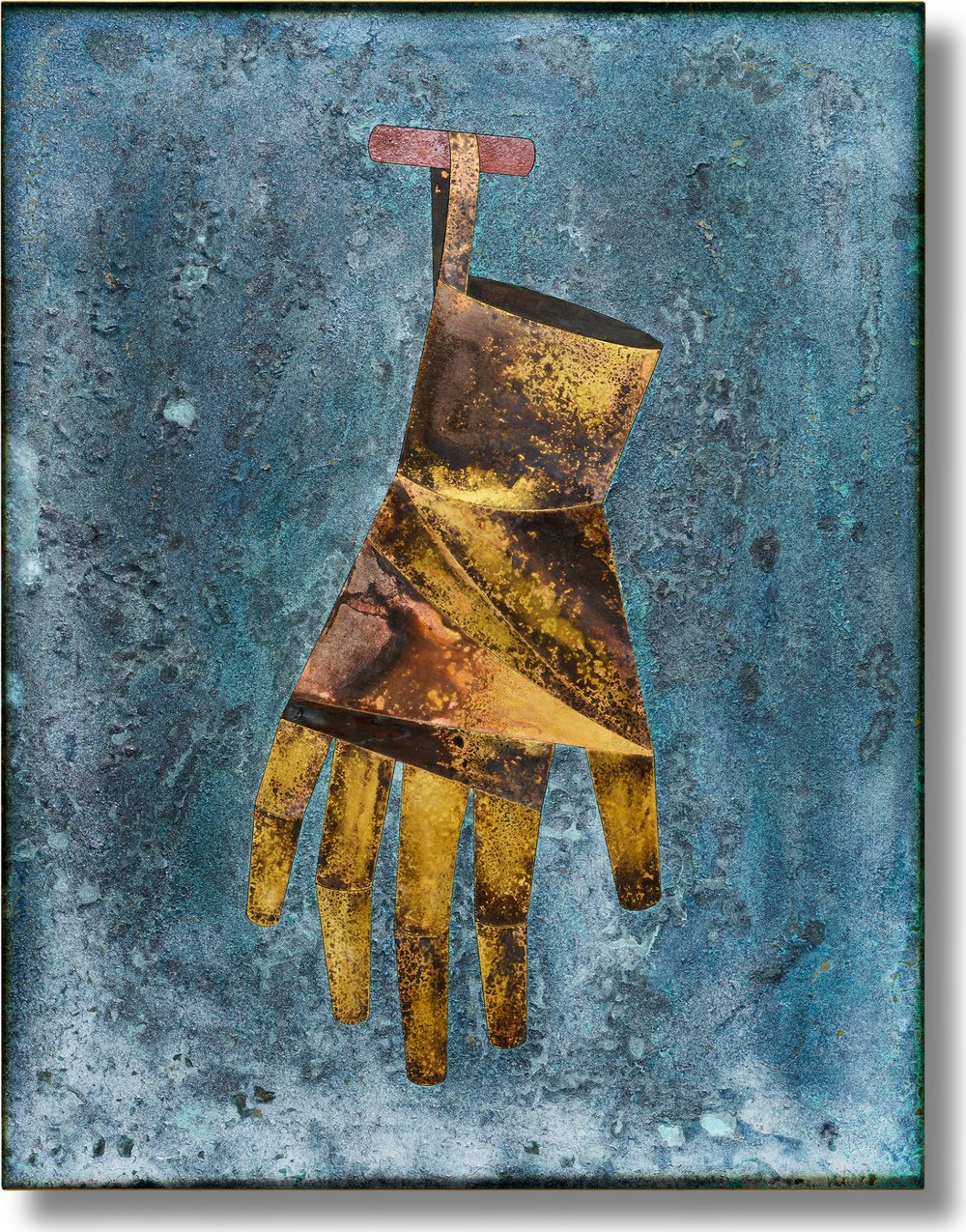
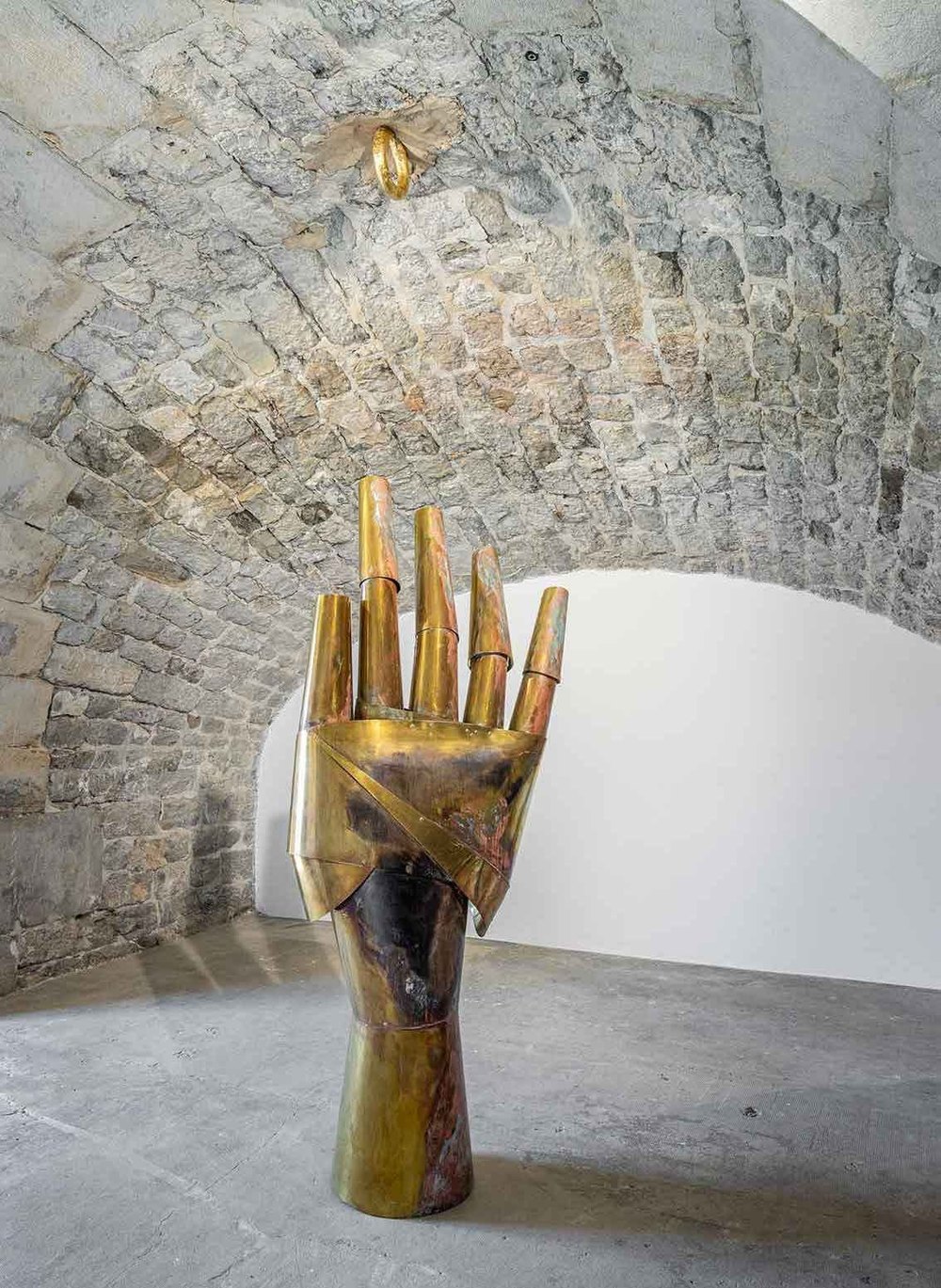
In the former Jean Prouvé school, a monumental hand greets us under the covered playground, right at the entrance. Set before a basketball hoop, it seems startled by our arrival, as if caught in the middle of break time. The hoop, in its original place, awakens the memory of the site and recalls that a school is also made of games, playtimes and shared moments. The hand, a figure of making so dear to the artist, seems in turn to designate the school as a place where knowledge is also acquired through gesture and experience. In the corridor, a marquetry depicting a glove seems to echo this hand. On the left, the coat hooks have kept their place. Does the glove belong to a child who hung it there before going into class? We remember coats hanging side by side, pockets rummaged through one last time. Higher up, a key in marquetry catches the eye. It remains at a distance, with its promise of opening something.
The classroom seems already to be living without us. From the threshold, we feel we are not quite where we belong. What have we come to do in this assembly, so joyful and so lively? On a white paper board, geometric instructions sketch the shapes to be made. The metal sculptures set out on the desks gradually reveal the nature of the exercise: an arts and crafts workshop devoted to the representation of the human figure.
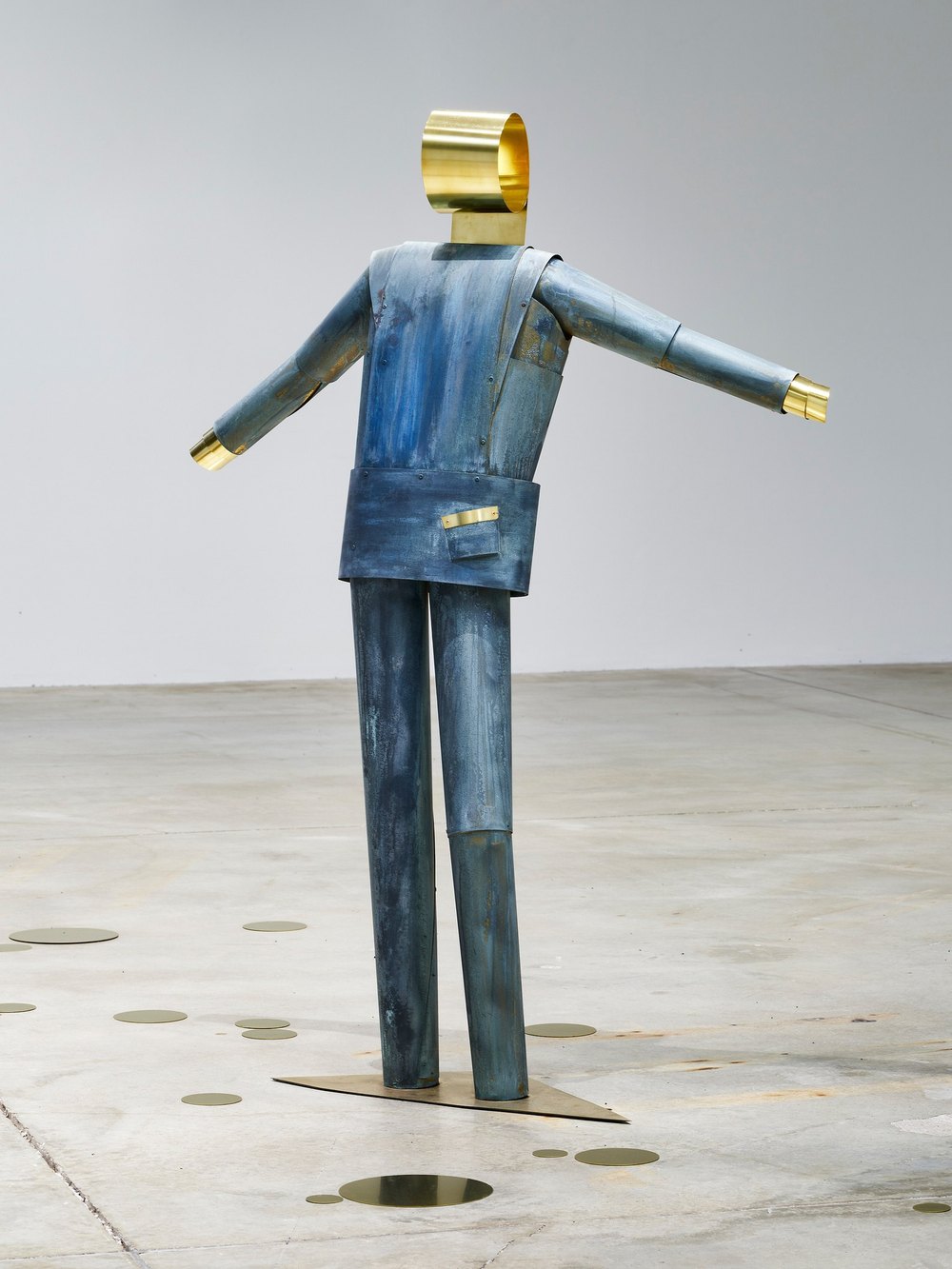
Seated at the original desks designed by Jean Prouvé, the pupils seem to be diligently reproducing the method set out on the board. In their attitudes we recognise the familiar gestures of the classroom: leaning over one’s work, turning towards a neighbour. On their desks, their creations, still clumsy, come to life. The sculptures seem animated, engaged in silent exchanges. We feel almost embarrassed to move among them, as though our presence had disturbed a moment of intimacy and these figures, suddenly shy, had frozen. A glance, a posture, an orientation is enough to suggest a relationship. What is at stake then seems to shift: it lies less in the sculptures taken one by one than in the bonds woven between them, in what plays out between bodies, attitudes and presences. On the back wall, the motif of a radio, drawn in metal marquetry, lends this collective life an almost audible dimension. The installation thus seems to hold on to the murmur of conversations that our arrival would have interrupted.
In the next room, taps release drops of brass. We almost feel cold water on our hands again, while the sound of a dripping tap returns in the silence. The piece evokes both a place meant for children and an original source, where matter seems to be born and transformed. The metal keeps the shape of what flows, as if stopped just before falling. Brass, the artist’s material of choice, can be recast, reused and metamorphosed. Patination techniques also alter its appearance, revealing nuances and states of surface that constantly renew our perception.
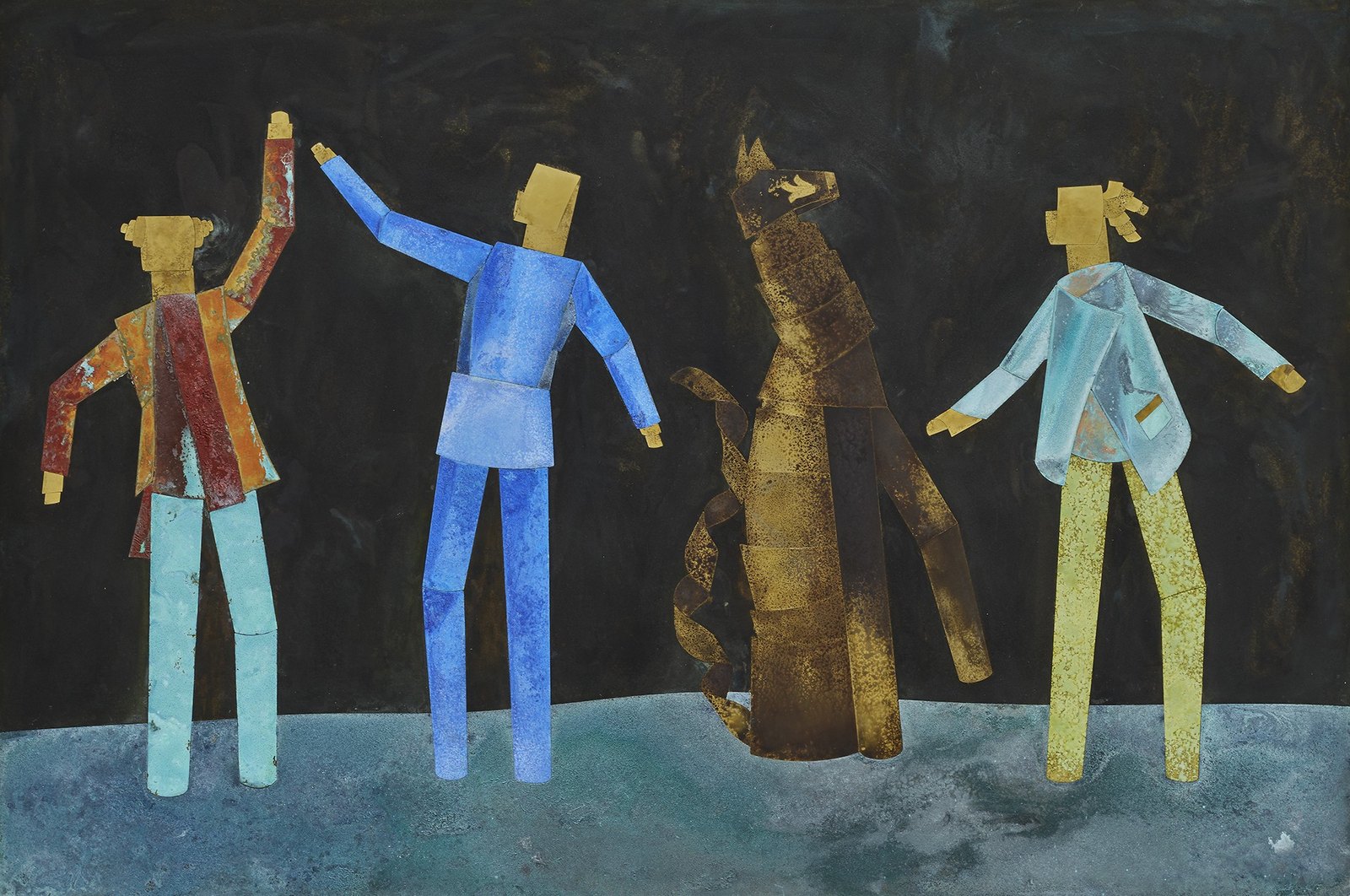
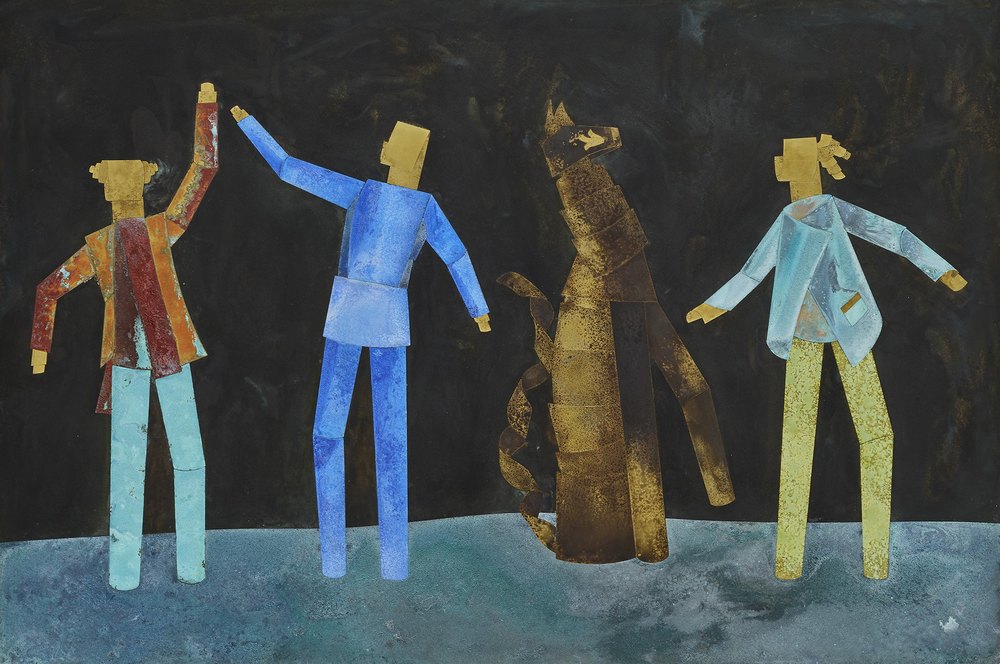
On the walls, this play of surfaces and colours gives body to the characters of the patinated brass marquetries. Their gestures are fixed in the image; alone or gathered in groups, they seem to carry on their exchanges. Nearby, metal collected in a bucket seems to be waiting to take shape in its turn. Beside these already recognisable figures, it recalls that matter remains open to other bodies, to other identities. A question then arises: are we, as human beings, capable of reinventing ourselves with the same freedom?
In the second building, the film screening seems already to have begun. Metal spectators occupy the seats, absorbed in the projection; we take our places beside them. On screen, human figures and metal creatures share situations and roles, with no hierarchy seeming to emerge between them. Any of them can play a character and take part in a story. The artist’s creatures become spectators, actors and perhaps the protagonists of their own narrative. We came to look at them; now we look with them.
The title Par cœur (By Heart) resonates between the classroom and the screen. It refers to learning and memorisation, but also to cinema, where everyone takes on a role and learns to embody an identity. The heart also evokes the living, the emotions and that singular part of human experience which partly escapes any attempt at formalisation. Learning by heart, playing a role, giving form to an emotion: so many gestures that run through the exhibition and question the boundaries between imitation, embodiment and invention.
Are we immersed in the artist’s matrix, at the heart of a universe peopled by her many personalities? Her creatures seem to imagine themselves capable of reinventing themselves, as if their existence could now continue independently of their maker’s. At a time when artificial intelligence is renewing our questions about creation and the reproduction of the living, this impression of autonomy takes on a particular resonance. And yet everything about them recalls matter and the work of the hands. Their imperfect forms, their sometimes hesitant silhouettes, their cut-outs and their oxidations lend them a personality that seems to emerge from their very roughness. We recognise an attitude, an expression, a way of standing among others. Against the smooth image of an entirely virtualised world, their presence remains fragile, expressive and singular. These figures may lead us back to an ancient human desire: to reproduce one’s appearance and extend one’s presence beyond oneself, through painting, sculpture, photography, cinema or virtual images.
But what remains of us when our image becomes autonomous? And what if, in seeking to represent the living, we had ended up creating figures capable, in turn, of looking at us, of playing and of telling one another their own stories?
Works on view8

Note
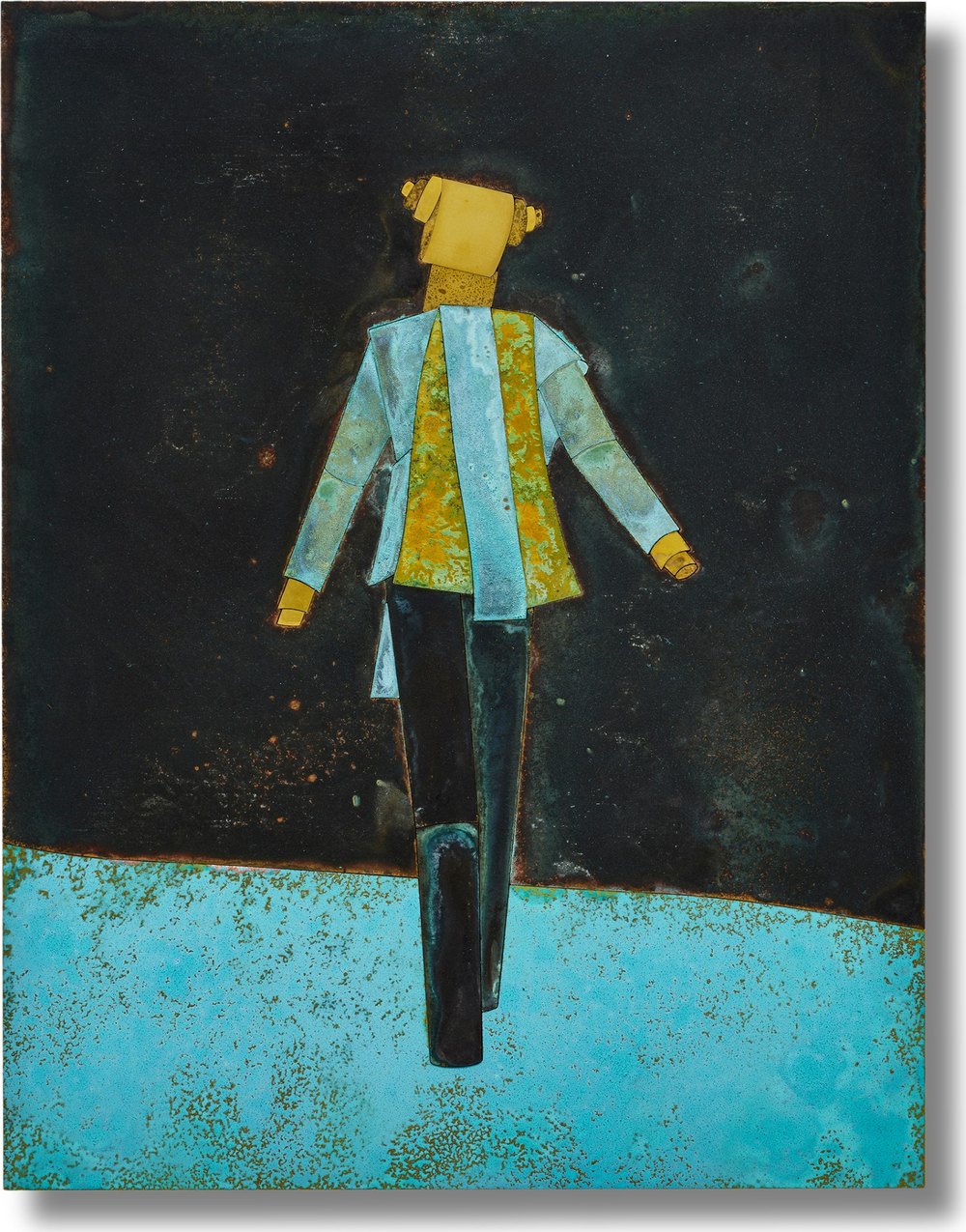
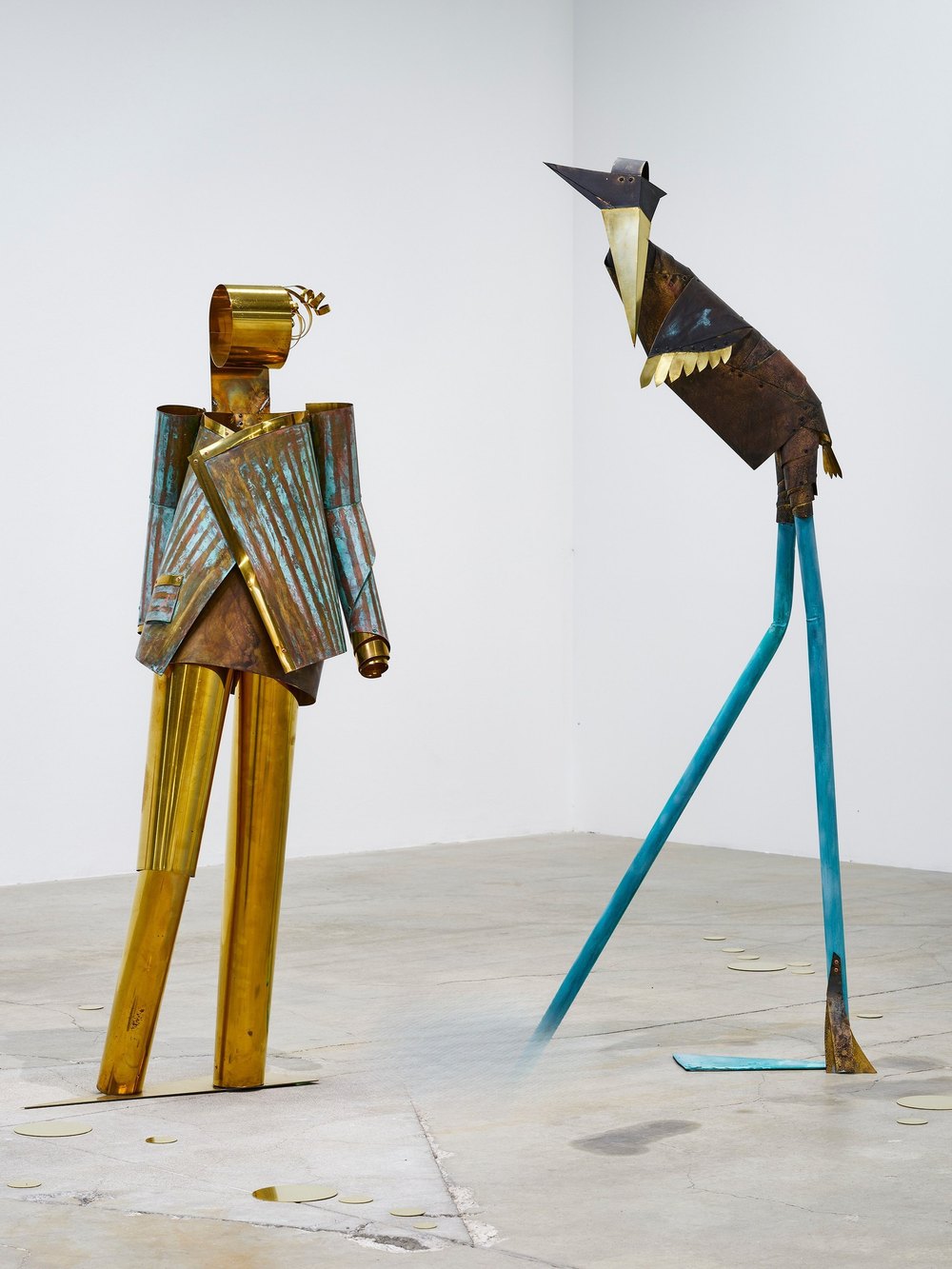
Manuela has turned her head. This slight movement is enough to give brass the bearing of a person. Her long arms fall on either side of a garment with overlapping panels; her golden legs extend the silhouette to the floor. She seems to have paused mid-stride to listen. We arrive in the midst of a scene whose opening words we have missed.
Caroline Mesquita allows each cut, each fold, to suggest a gesture. The metal curls into a hollow head, unfolds into fabric, narrows at the wrist. A few delicate tendrils escape behind the absent face. This almost mischievous detail holds our attention: a singular grace emerges from this metamorphosis, while the figure’s stance conveys a velleity of movement. The body seems poised to resume an action suspended by our arrival.
“There is a life of forms,” wrote Balzac in The Wild Ass’s Skin. Before Manuela, these words acquire a particular resonance. Across the torso, oxidation draws turquoise streaks through shades of brown. A golden lustre emerges along the edges, lingers in the hollows, and runs down the legs. Light travels across this brass skin, continually renewing its reflections. Manuela keeps her silence. Yet we find ourselves searching for her gaze where the metal opens onto emptiness.
Note
Hand rises from the floor as though an immense body lay buried beneath it. Taller than the viewer, the hand raises its fingers and presents its palm. A greeting, a warning, a silent plea? The gesture is familiar, yet its scale holds its meaning in suspense. We approach with the hesitation that sometimes precedes a first touch.
Caroline Mesquita gives brass a singular plasticity. Rolled into cylinders, sheets of metal become fingers; their seams suggest joints. Overlapping planes cross the palm, somewhere between folds of skin and fragments of armour. Everything seems constructed for a movement still to come. The hand might close, restrain, protect. Oxidation darkens certain surfaces, leaving coppery hues, while light lingers along the golden edges. Our gaze traces these irregularities like the lines of a palm in which we might seek to read a destiny.
“What hands are here!” exclaims Macbeth, overcome with horror at the sight of his own hands. His words find an echo here in the uncanniness of a bodily fragment that has acquired a presence of its own. To whom does this hand belong? What gesture has it just performed? Yet the slight irregularity of its fingers lends it something vulnerable, almost tender. Its palm remains open. We stand before it, in the fragile interval between what might welcome us and what might hold us back.

Receive the selection of works from this exhibition.
Press High-resolution images, interviews, visits →